Magic After Modernity - Santa Claus

Children no longer believed in magic enough to sustain large-scale operations.
Not because they were cruel. Not because they had stopped hoping. The problem was efficiency. Modern children receive electronically optimized joy year-round. Infinite entertainment. Same-day shipping. Personalized recommendations. The old rituals had weakened beneath the weight of convenience and the increasing speed of the internet. Hard to keep a list and certainly no more need to check it twice.
And so, like many ancient entities before him, Santa adapted. By the time the reindeer were sold to a Scandinavian eco-tourism company, the situation had become impossible to ignore.
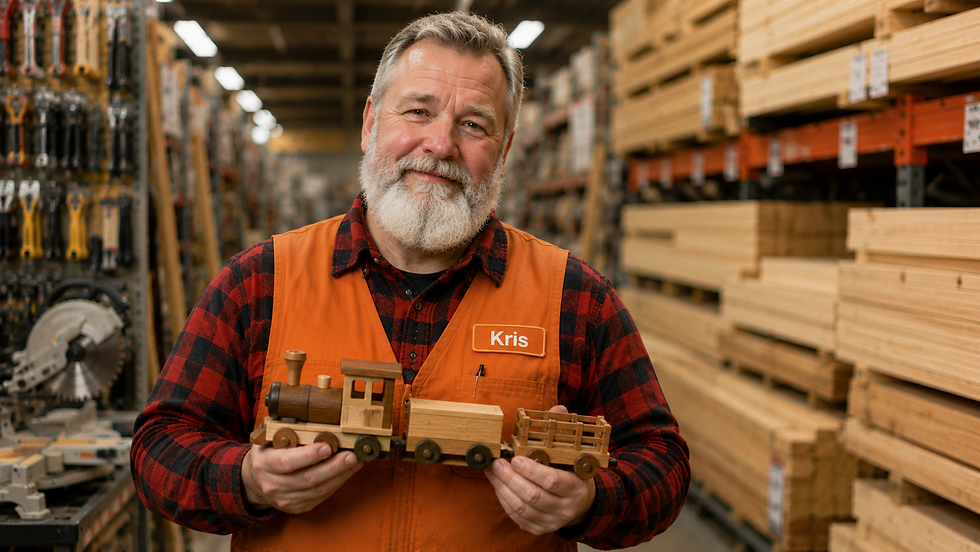
Now he works weekends at The Home Depot and occasionally at Lowe's Home Improvement giving free community workshops titled:
“Handcrafting Wooden Toys for a More Meaningful Holiday.”
Attendance is usually sparse. Six exhausted parents. One grandfather who already owns the tools. A divorced dad trying to salvage his childhood and the relationship with his daughter. Sometimes a woman who wandered in looking for gardening supplies but stayed because the old man teaching reminded her vaguely of safety and winters from childhood.
Santa wears flannel now, topped with an orange or blue vest depending on store, always with the embroidered “Kris” on the chest.
The red suit only comes out in December, and even then it looks less ceremonial and more like an aging union mascot at a regional parade. The beard remains authentic, though thinner than legend remembers. His hands are enormous and scarred from centuries of carving oak, ash, cedar, and pine. Hands that once shaped toys infused with wonder now demonstrate proper sanding technique and wood glue curing times under fluorescent lighting.
“Children remember effort,” he tells the class quietly while helping someone align wooden wheels on a toy truck. “Not perfection. Never perfection.” Nobody writes that part down, they just nod as if they hadn’t heard the lesson for the first time.
The elves still exist, of course, but most have transitioned into manufacturing consulting, specialty fabrication, or Etsy storefront optimization. One runs a highly successful YouTube channel doing reviews of Amazon products. Another vanished entirely after discovering 3D printers.
The workshops themselves are strange to the outside observer:
The room smells faintly of peppermint despite the lumber section nearby. Tools occasionally move on their own when nobody is looking directly at them. Wooden trains made during the class sometimes survive generations without warping. Parents who arrive distracted often leave quieter. Softer somehow. Every so often, usually near closing time, a child peeks around the corner of the workshop area and freezes.
Because for a split second, in less time than it takes the blink of an eye, they do not see an old craftsman in an apron. They see the real thing:
The broad silhouette. The impossible warmth. The ancient and terrible kindness of a being who crossed the world simply because children once believed joy should arrive in the night, not in an Amazon package.
Then the moment passes, the sounds of commerce and the hum of florescent lighting of a home improvement store returns, and the employee goes back to explaining the proper way to apply wood stain.


Comments